
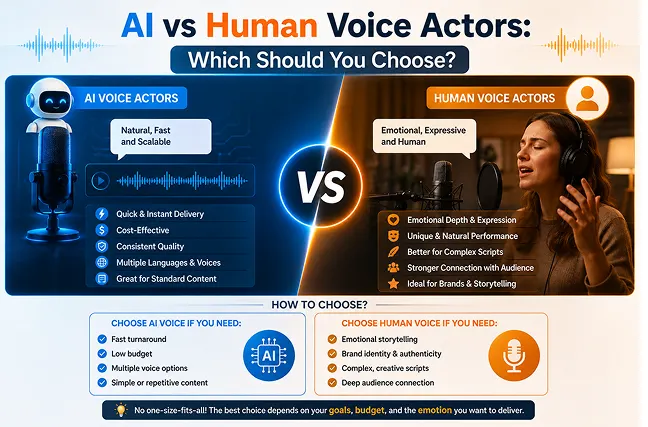
Today, AI speech technology produces incredibly lifelike neural audio with nuances of micro-prosody and emotion. When deciding whether to use AI Voice Generation technologies such as ElevenLabs, PlayHT, and Murf.ai versus working with live voice actors, you must analyze your project’s feasibility from the perspective of speed, budget, scope, and emotional intensity.
This guide provides a detailed description of the benefits and drawbacks of both methods, allowing you to make the best choice for your project.
Above-the-Fold Breakdown: AI Voice Generators vs. Human Voice Actors
Voice Production Matrix · Neural TTS vs. Professional Voice Talent
| Feature / Metric | AI Voice Generators (Neural TTS) | Human Voice Actors (Voice Talent) |
|---|---|---|
| Turnaround Time | Instant to 2 minutes per script rendering | 24 to 72 hours (Booking, recording, editing) |
| Cost Scale | $0 – $30/mo (Subscription based) | $100 – $1,000+ per session/project |
| Emotional Depth | Moderate (Algorithmic emotion presets) | Unmatched (Nuanced subtext & storytelling) |
| Directability | Re-prompting, sliders, & viseme mapping | Live direction ("Say line 2 with more sarcasm") |
| Multi-Language Scale | Instant automated dubbing (50+ languages) | Requires hiring localized native speakers |
| Usage Rights & Ethics | Platform Terms of Service | Formal Talent Contracts & SAG-AFTRA Rules |
| Best Target Use Case | eLearning, internal videos, dynamic ads, software updates | Super Bowl ads, audiobooks, video games, brand films |
1. Deep Dive: AI Voice Generation
AI voice engines produce audio from written words thanks to complex algorithms. This process requires knowledge of countless voices.
1. Core Advantages
- Very Quick: This technology allows the user to produce hours of content in a matter of seconds, which allows the easy implementation of changes to the script.
- Huge Savings: This solution saves up to 90% of voiceover costs. Startups are now able to afford large amounts of engaging audio content.
- Voice Cloning in Different Languages: Now the user can transform a voice sample into different languages keeping its inflection and emotional tone.
2. Key Limitations
- Absence of Complicated Meaning: Artificial intelligence can have difficulties finding different nuances of emotions, such as irony or a complex plot that is needed for narrative storytelling.
- Legal & Ethical Challenges: Issues like illegal voice replication or changes in the standard terms of use can bring legal issues into play if commercial rights are not clear.
2. Deep Dive: Human Voice Actors
Professional voice performers bring emotional richness, artistic guidance, and distinctive personality representations to a script.
1. Core Advantages
- Emotional richness and authenticity: Humans utilize their ability to modify pitch, breathing, and speed of delivery to create authentic emotional bonds with the audience.
- Real-time artistic guidance: Voice actors can be directed during the recording session so that they can provide the right takes.
- Increased trust in the brand: Audiences relate to human beings; thus, voice of real people is suitable for major advertising campaigns and storytelling.
2. Key Limitations
- High Cost & Time: Booking studio time, casting talent, and managing audio revisions takes time and requires higher budgets.
- Bottlenecked Edits: Changing even a single sentence weeks later requires re-booking the voice actor and matching the original recording setup.
3. Decision Making Process: How To Pick The Right Option?
1. Select Artificial Intelligence voice production when:
- Your business has many corporate training videos, online courses or software guides to produce regularly.
- Your brand has hyper-active social media presence and the content needs to get up-loaded daily.
- Budget constraints require you to get your content translated and localised into over 10-15 languages.
2. Select Human Voice Actors when:
- You are making high profile TV advertisements, commercials or Super Bowl ads.
- You are creating a character-centric story line such as a video game, animated film, or an elaborate audio-book.
- Your brand image depends on a particular voice of a company representative.
Technical Capabilities & Production Constraints Matrix
(Note: Evaluating distinct operational parameters outside of basic time and cost metrics)
| Technical / Production Vector | Neural AI Voice Pipelines (ElevenLabs, PlayHT, Murf) | Professional Human Voice Talent Workflows |
|---|---|---|
| Phoneme & Viseme Synchronization | Automated Milli-Second Alignment (Direct mapping to visual 2D/3D lip movement frames). | Requires manual audio-to-video alignment or NLE time-stretching by an editor. |
| Acoustic Environment Control | Pure Dry Digital Stems (Zero room reverberation, reflection, or mic noise floor). | Subject to studio acoustic treatment, mic capsule characteristics, and preamp warmth. |
| SSML & Prosody Fine-Tuning | Code-Driven Control (Precision tags for <break time="500ms"/>, pitch shifts, and emphasis). |
Directed via natural language, acting cues, live session feedback, and artistic intuition. |
| Copyright & Legal Indemnity | Platform SaaS Terms (Check licensing limits, model training consent, and commercial usage rights). | Standard union contracts (SAG-AFTRA), explicit buyouts, and clear usage right protection. |
| Script Ingestion & API Automation | Programmatic REST API Ingestion (Real-time dynamic text-to-audio rendering). | Manual script delivery, booking, and recording passes per batch. |
Request A Custom AI Video
Tell us what you're trying to create and we'll point you to the right tool — or help you set it up.
4. Audio Engineering Deep Dive: The Tech Behind Neural Voices
Modern synthetic voice technology is based on two major types of neural networks working together:
[Text & SSML Script] ➔ [Acoustic Model (e.g., FastSpeech 2 / VALL-E)] ➔ [Mel-Spectrogram Pass]
                                                                                                │
                                                                                                ▼
[Clean 24-bit Audio Master] ◄── [Neural Vocoder (e.g., HiFi-GAN / WaveNet)] ──────┘
- Acoustic Models: The system transforms writing characters and Speech Synthesis Markup Language (SSML) tags into Mel-Spectrograms (visual maps of sound frequency across the time axis).
- Neural Vocoders: A neural network generates Mel-Spectrograms into audio waves, filling in small details present in human voices (pauses, vocal fry, pitch).
5. Resolving AI Voice Artifacts (Audio Post-Production)
Neural audio models offer good quality audio output but they also come up with synthetic flaws. Make use of the following steps to eliminate these problems seeing through your digital audio workstation (DAW):
- How to Get Rid of "Metallic Buzz": To do away with the artificial digital resonators while applying parameters of vocoder, use a very narrow dynamic notch filter operating at 8kHz - 12kHz.
- How to Make Artificial Voice Sound the Way Natural Voice Does: Using synthetic voices in your recordings may make them sound boring, because the artificial voice will have no dynamics for long time. It is highly recommended to use Vocal Volume Automation technique that allows for minor deviations in voice volume of roughly 1.5dB.
- How to Improve Smoothness of Sound: AI voices may occasionally be too loud in the rendering of consonants sound like sibilants (S, T, Z). Use Sibilance Splitter/De-Esser which will work at 6kHz in order to soften the toughest sounds before the mastering process.
AI vs Human Voice Talent Primer
Compare emotional resonance, production speed, cost structures, and copyright licensing rules.
Human voice actors perform dialogue organically, adjusting pitch, breath control, and emotional inflection in real time. AI voice synthesis uses deep neural text-to-speech (TTS) models trained on vast datasets of recorded human audio. The AI maps written phonemes to speech waveforms, generating natural-sounding spoken audio directly from text scripts without requiring a physical recording environment.
Choose Human Voice Talent for projects where deep emotional connection, subtle sarcasm, complex character acting, or authentic brand personality are paramount. High-stakes Super Bowl commercials, emotional audiobooks, character-driven video games, and flagship narrative films still rely on human actors to deliver authentic, heartfelt performances that AI cannot fully replicate.
Choose AI Voice Generation when prioritizing rapid turnaround times, high-volume output, and tight production budgets. AI voices excel at corporate e-learning modules, daily YouTube faceless channels, rapid social media A/B ad testing, personalized sales outreach videos, and dynamic software walkthroughs where text updates occur frequently.
Hiring professional human voice actors typically costs between $150 and $1,000+ per finished finished audio minute, plus studio rental fees and usage rights licensing. AI voice synthesis platforms operate via SaaS subscriptions (ranging from $15 to $99/month), allowing creators to generate unlimited or multi-hour voiceover tracks at a fraction of the cost.
AI voice tools provide near-instant speed and flexibility. If a script changes, an editor can rewrite a sentence in text and re-generate the entire audio file in seconds. Working with human voice talent requires sending revision requests, re-booking studio sessions, waiting days for re-recordings, and paying additional pickup fees for script modifications.
Cross-lingual AI models (like ElevenLabs or Coqui) can translate and re-voice a single recording into 40+ languages instantly while cloning the original speaker's vocal tone. Human localization requires sourcing, hiring, and directing separate native voice actors for every target country, which is vastly more expensive and time-consuming despite yielding slightly more authentic cultural idioms.
Cloning a human voice without explicit, written legal authorization violates right-of-publicity laws and regulations like the NO FAKES Act. When using AI voice engines, creators must use legally licensed stock AI voices provided by the platform or obtain signed contractual voice model rights from the human actor whose voice was cloned.
Many modern production studios use a Hybrid Strategy. Production teams hire a professional human voice actor to record main commercial tracks or key narrative hooks. The actor's voice is then officially cloned (with full compensation and contractual royalty agreements), allowing the studio to use AI voice synthesis for rapid localization, minor line fixes, and routine promotional updates.
For standard explanatory speech, news reading, and instructional tutorials, modern neural TTS models (like ElevenLabs or Fish Audio) are virtually indistinguishable from human speakers. However, in emotional acting scenes requiring extreme laughter, crying, intense anger, or subtle vocal cracks, human listeners can still detect the lack of organic breath control and emotional cadence in AI renders.
Follow this simple rule: Choose Human Voice Actors if your video relies heavily on emotional connection, high-stakes brand identity, character acting, or complex narrative nuance. Choose AI Voice Generation if your goal is scaling high-volume social content, translating videos into multiple languages rapidly, updating software tutorials routinely, or building faceless YouTube channels on a tight budget.
Ready to try Skora AI?
Transform your ideas into cinematic video in seconds.