
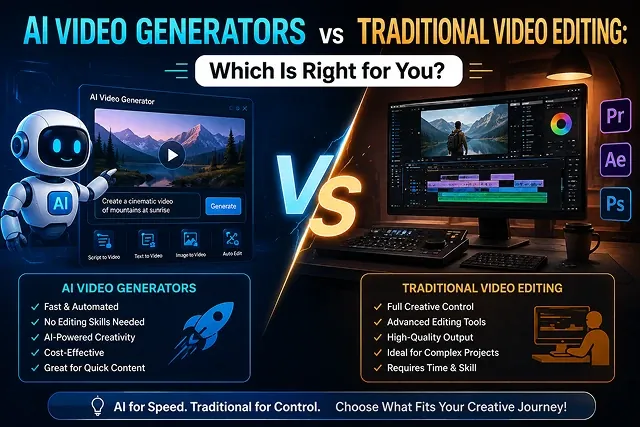
The advent of artificial intelligence has changed the landscape of digital media creation. Whether or not to use an AI video generator (such as Sora 2, Google Veo 3.1, Kling 3.0, or Wan 2.2) or a traditional video editor (where you would use non-linear video editors like Adobe Premiere, DaVinci Resolve or Final Cut Pro) will depend on features such as speed needed, how much will be spent, how creative the task becomes, and depth of narrative.
The next section will provide you with an insightful comparison that will help you decide what method will suit you better.
Above-the-Fold Breakdown: AI Generators vs. Traditional Editing
Production Decision Matrix · Generative AI Workflows vs. Timeline-Based Editing
| Decision Metric | AI Video Generation (Generative/Prompt-Driven) | Traditional Video Editing (Timeline-Based NLE) |
|---|---|---|
| Turnaround Speed | Minutes per scene (Rapid draft-to-render output) | Hours to weeks (Filming, ingest, cutting, grading) |
| Production Cost | Low ($0 – $50/mo SaaS subscription costs) | High (Cameras, lighting, crew, actors, software fees) |
| Creative Control | Prompt-guided (Iterative, non-deterministic outputs) | Frame-exact precision (Absolute control over keyframes) |
| Learning Curve | Minimal (Natural language text & image prompting) | Steep (Requires mastery of NLEs, color, audio, and FX) |
| Scalability & Volume | Infinite variations (Ideal for A/B testing & batching) | Linear investment (Each new scene requires physical labor) |
| Best Target Audience | Marketers, solo creators, educators, & social media teams | Narrative filmmakers, commercial directors, & documentary editors |
1. Deep Dive: AI Video Generation
AI video platforms utilize multimodal diffusion transformers (DiTs) to synthesize video, motion, and audio directly from text or static reference images.
1. Core Advantages
- Fast Production of Large Quantity: Videos can be produced quickly within minutes allowing you to upload content daily across social media platforms including TikTok, Shorts, and Reels.
- Low Cost Barrier: No need for expensive settings, cameras, actors, or transportation.
- Concept Experimentation: Facilitates complex scenes or settings that would be impossible to film without physical restrictions.
2. Key Limitations
- Precision Control Caps: Models can occasionally misinterpret spatial directions, warp hands/faces, or fail to enforce strict brand positioning.
- Generative Artifacts: High-motion scenes may display visual melting or continuity errors between frame cuts.
2. Deep Dive: Traditional Video Editing
Unlike AI, traditional editing methods use a person to steer the video production process through the use of a software tool.
1. Core Advantages
- Frame Accurate: The editors have every little detail under control including each frame, audio mixing, grading and speed of a video.
- Authenticity & Trust: Using a real human face, physical interaction and real interviews strengthens audience's trust.
- Complexity of Narrative: The use of this method is important in making long feature films, commercials or documentaries.
2. Key Limitations
- High Costs & Time Consumption: Video shooting involves the selection of shooting dates, locations, payment for actors and lengthy time duration.
- Bottlenecked Scalability: In order to create 20 versions of the same ad campaign manual editing time has to be multiplied.
3. Decision Framework: Which Workflow Fits Your Project?
1. Choose AI Video Generation If:
- You run high-frequency social media marketing channels that require rapid content iterations.
- You need to create quick product concepts, pitch decks, or visual B-roll without a physical camera crew.
- You have a limited budget and need fast, self-contained video assets.
2. Choose Traditional Video Editing If:
- You are creating a high-class brand video, advertisement, or documentary that necessitates precise control over the frames.
- Your assignment is based on genuine real-life human reviews, happenings, or product presentation where authenticity is paramount.
- You require strict pixel-level color management and multitrack audio engineering.
1. Direct Comparison Matrix
Production Decision Benchmarks · AI Video Generation vs. Traditional Editing
| Factor | AI Video Generation | Traditional Video Editing |
|---|---|---|
| Primary Process | Prompt-driven generation using neural models. | Manual timeline cutting of captured/stock footage. |
| Speed & Turnaround | Minutes to hours per video draft. | Days to weeks per project. |
| Cost Overhead | Software subscriptions ($0–$60/mo). | Production gear, location fees, and labor. |
| Creative Control | Guided by text prompts, reference maps, and seeds. | Frame-accurate precision over cuts and audio. |
| Learning Curve | Low (prompt writing & basic tool navigation). | High (requires mastering NLE software & color grading). |
| Scalability | High (instant A/B testing & batch variations). | Linear (requires proportional editing time per version). |
Request A Custom AI Video
Tell us what you're trying to create and we'll point you to the right tool — or help you set it up.
4. The Mix Method: Putting AI and Traditional NLE to Work Together
Today’s production companies do not see this as a zero-sum problem. The perfect solution is the best mix of both processes:
[AI Prompting Pass] ➔ [Generate Base Clips / CGI] │ ▼ [Conventional NLE Pass] ➔ [Color Treatment + Sound Reduction + Cropping] ➔ [Master Output]
By creating the necessary B-roll, background visuals, or synthetic voice using AI algorithms and then inserting them into a classic editing software for the editing process, the production houses achieve both speed and great artistic precision.
5. Quantitative Cost & Scalability Math
The financial decision comes down to Fixed Software Subscriptions vs. Variable Production Labor.
The Production Cost Formula:
- Cost_Traditional = Equipment + Location + Talent + (Editor Hourly Rate x Hours Spent)
- Cost_AI Engine = Platform Subscription + (Generation API Credits x Render Passes)
Scalability Curves:
- Generative AI Video: Near-zero marginal cost per additional video variation. Generating 20 A/B ad test variations requires simply swapping text tokens or seeds, keeping labor time virtually flat.
- Traditional Editing: Scaling output scales linearly with human editing hours. Trimming, cutting, and re-exporting 20 custom aspect ratio deliverables requires proportional editor time.
6. The Professional Hybrid Workflow Pipeline
Instead of choosing one isolated tool, high-volume production teams use generative AI engines as asset generators and NLEs as assembly hubs:
1. Generate B-Roll & Visual Extensions via AI
- Generate secondary B-roll shots, impossible environmental background extensions, or stylized visual effects using an engine like Google Veo 3.1 or Wan 2.2. Export files using uncompressed ProRes 422 HQ or high-bitrate AV1.
2. Ingest & Timeline Assembly in NLE
- Bring your generated clip with a virtual camera take into DaVinci Resolve or Premiere Pro. Refine scene pacing and cut to narrative beats through frame accurate editing.
3. Apply Scene Color Matching & ACES Profiles
- Run NLE neural color tools (like DaVinci's Neural Engine) to automatically match the color science and lighting curves of synthetic AI clips to your physical camera sensors.
4. Multitrack Audio Engineering & Master Export
- Apply Sidechain Audio Ducking to drop background scores by -16dB behind primary dialogue tracks. Export final localized renders across vertical (9:16) and horizontal (16:9) viewports.
AI vs Traditional Video Editing
Compare production speed, cost structures, creative control, and learning curves to pick the right workflow.
It comes down to Synthesis vs. Manipulation. Traditional video editing relies on human editors manually arranging, cutting, color-grading, and stitching recorded real-world footage or pre-rendered 3D assets along a linear timeline. AI video generators create brand-new video frames, camera movements, and audio tracks directly out of text scripts or base reference images using cloud-based neural networks.
AI video tools offer massive speed advantages. Generating a 30-second promo or explainer clip via AI tools (like InVideo or Runway) can take anywhere from 5 to 30 minutes. A traditional editing workflow—which involves shooting physical footage, setting up studio lights, organizing media files, cutting, and performing manual color correction—typically requires several days or weeks to deliver a final master edit.
Traditional editing wins decisively on precision. Non-linear editors (NLEs) like DaVinci Resolve or Adobe Premiere Pro give you frame-by-frame authority over audio tracks, color curves, graphics placement, and camera cuts. While AI prompt tools are fast, they operate with a degree of randomness—making subtle, exact tweaks to specific background objects or character expressions harder to control without generating entirely new clips.
Traditional video editing carries heavy upfront investments: professional cameras, lenses, lighting arrays, microphones, and high-performance editing computers. AI video generators replace physical production hardware with web-based software subscriptions (often ranging from $15 to $60/month), making high-end visual production accessible to solo creators working without a production crew or studio space.
Traditional video editing software involves a steep learning curve that requires mastering timeline tracks, keyframe animation, color wheels, audio scrubbing, and codec settings. AI video platforms feature minimal learning curves; users can generate complete video assets simply by writing natural language text prompts or selecting template settings in a web browser.
Traditional filming offers absolute physical consistency. Real actors, products, and physical props look identical across every camera angle. AI video generators can suffer from "visual drift," where character faces, outfits, or corporate logos subtly change between generations. However, using Image-to-Video references and character LoRAs in AI workflows has significantly narrowed this gap.
AI video generators excel at rapid social scaling. If you need to publish multiple vertical videos daily across TikTok, YouTube Shorts, and Instagram Reels, AI tools can generate scripts, B-roll visuals, voiceovers, and auto-captions in minutes. Traditional editing is usually reserved for higher-stakes, long-form content where emotional nuance matters most.
Modern non-linear editors (like Adobe Premiere Pro and DaVinci Resolve) now feature embedded AI tools directly on the timeline. Editors use AI for automated speech-to-text transcription, text-based rough cutting, AI noise isolation, automated object masking (rotoscoping), and smart scene-re-framing—combining traditional timeline control with AI speed enhancements.
Videos created using traditional filming and manual editing automatically qualify for full copyright protection because they are created by human authors. Unmodified AI-generated video outputs cannot be copyrighted on their own under current legal guidelines. To secure enforceable copyright over AI content, creators must introduce substantial human editing, manual arrangement, and creative modifications.
Choose AI Video Generators if you need to produce content quickly on a budget, manage faceless automation channels, generate rapid social media Shorts, or create stylized concept videos without physical cameras. Choose Traditional Video Editing if you are filming real humans, producing high-end client commercials, making narrative films, or requiring frame-by-frame control over every detail.