
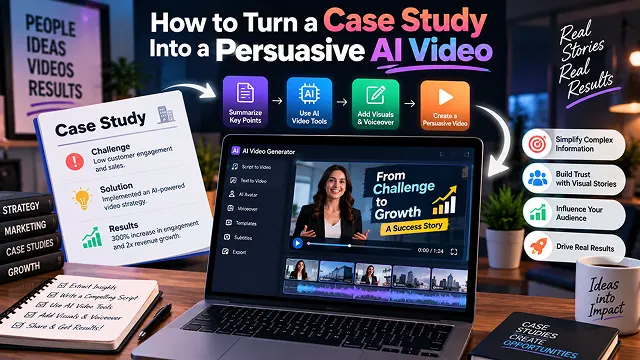
Case studies are certainly among the most effective tools in B2B marketing, but prospective buyers hardly have enough time to read through lengthy papers. Repurposing traditional case studies into short AI videos makes it possible to convey the information optimally and shorten time spent on closing deals.
Thanks to automated AI video-producing systems, it is possible to develop and produce ready-to-broadcast case study videos using only the written project brief instead of cumbersome technical resources, such as animations or audio or the voice.
Above-the-Fold Feature Matrix: Traditional Case Studies vs. AI Video Transformations
B2B Content Conversion Matrix · Traditional Written PDF Case Studies vs. AI-Generated Video Case Studies
| Performance Metric | Traditional Written PDF Case Study | AI-Generated Video Case Study |
|---|---|---|
| Buyer Consumption Rate | Low (10% to 15% complete read-through) | High (Over 70% completion rate for sub-60s videos) |
| Production Cycle | 3 to 6 weeks (Interviews, drafts, layout design) | 30 to 45 minutes (Script parsing to 4K export) |
| Production Cost | $1,500 – $4,000 (Copywriters + graphic design) | $0 – $30/mo (Web browser SaaS & open engines) |
| Sales Enablement Impact | Buried attachments in cold outreach emails | Clickable thumbnail links boosting email reply rates |
| Metric Memorability | Numbers lost in walls of body copy | Animated kinetic data callouts centered on screen |
| Global Sales Scaling | English-only text distribution | Instant voice-cloned dubbing in 50+ languages |
1. Core Architectural Framework: The Data-to-Video Pipeline
Transforming raw technical case studies into video requires a four-tier pipeline:
[Raw Case Study PDF / Markdown Notes]
                │
                ▼
[1. LLM Extraction & Narrative Structuring]
  • Isolate: The Cost of Inaction (Friction)
  • Extract: Primary Architecture / Solution Implemented
  • Quantify: 2-3 Core ROI Metrics (Percentage / Dollar Value)
                │
                ▼
[2. Voice Synthesis & Kinetic Visual Cues]
  • SSML Pacing (ElevenLabs / Cartesia) with 400ms emphasis breaks
  • Dynamic B-Roll & Screen Capture Vectors (Kling 3.0 / Runway Gen-4)
                │
                ▼
[3. Programmatic Split-Screen Compositor (Remotion / FFmpeg)]
  • Left: Client/Representative Avatar or Narrator Presentation
  • Right: Animated Metric Tickers, Software UI Demos, & Before/After Graphs
                │
                ▼
[4. Multi-Channel Sales Deployment: HubSpot / LinkedIn / Fast-Loading Webpage]
The 4-Part "Hero's Arc" Script Architecture
Business purchasers want to minimize risk and maximize ROI. An effective case study video is structured as follows:
- The Bleeding Neck (0:00–0:20): Discuss the operational constraint of the client, technical issues, and the cost associated with inaction.
- The Catalyst (0:20–0:40): The point of decision-making—how conventional alternatives did not work out and how the selected option was adopted.
- The Architecture in Action (0:40–1:05): Description of the product that addresses the workflow constraint using screen recordings or interface animations.
- The Quantified Proof & CTA (1:05–1:30): The concrete results of doing business (X% improvement in productivity, $Y saved) followed by an invitation to schedule a consultation.
2. Operational Implementation Sequence
1. Extract Quantitative Transformation Data
- Use the entire written case study as input to the LLM model and type in "What is the main pain point of the client, explain how the solution architecture works and state 3 specific numerical results derived from the solution. Provide a 130-word voiceover."
2. Generate Product UI Keyframes & B-Roll
- For visual pacing, insert clean application screenshots and AI-generated environmental footage (like advanced data centers, logistics centers, or engineering workspaces) by making use of free Image-to-Video algorithms.
3. Synthesize Voiceover with Studio Acoustic Mastering
- Render the narrative audio via ElevenLabs using an authoritative, conversational voice profile. Apply light sidechain compression to set the vocal stem at -14 LUFS over subtle ambient background music.
4. Programmatic Motion Graphics Assembly
- Layer the narration, animated metric tickers, product UI demonstrations, and customer quote cards in Remotion or DaVinci Resolve. Use split-screen layouts to display visual evidence simultaneously with spoken claims.
Written PDF vs. Persuasive AI Video Case Study
B2B Conversion Matrix · Traditional 10-Page PDF Case Study vs. 90-Second AI Video Case Study
| Operational Dimension | Traditional 10-Page PDF Case Study | 90-Second AI Video Case Study |
|---|---|---|
| Prospect Consumption Rate | Low (< 18% read beyond executive summary). | High (70% — 85% completion rate). |
| Sales Cycle Impact | Passive collateral sent via email attachment. | Active sales enablement used in cold outreach and demo follow-ups. |
| Production Time | 2 to 4 weeks of design, copywriting, and layout. | 45 to 60 minutes end-to-end via automated pipelines. |
| Visual Proof Mechanism | Static 2D graphs and text quotes. | Animated UI interactions, metric counters, and executive voiceover. |
Request A Custom AI Video
Tell us what you're trying to create and we'll point you to the right tool — or help you set it up.
3. The 4 Sensory Anchors of a Persuasive Video Case Study
You should avoid just reading bullet points while using stock footage in a video case study. To gain the trust of B2B customers, it is necessary to create an emotional and analytical bridge with the help of four layers.
┌────────────────────────────────────────────────────────┐
│         The 4 Sensory Anchors of a B2B Video           │
└───────────────────────────┬────────────────────────────┘
                            │
        ┌───────────────────┼───────────────────┐
        ▼                   ▼                   ▼
┌───────────────┐   ┌───────────────┐   ┌───────────────┐
│ 1. Relatable  │   │  2. Concrete  │   │ 3. Dynamic 3D │
│   Conflict    │   │  Data Sparks  │   │  Asset Props  │
│ (Pain points  │   │ (Animated ROI,│   │ (Engine-ready │
│& bottlenecks) │   │  hours saved) │   │product models)│
└───────────────┘   └───────┬───────┘   └───────────────┘
                            │
                            ▼
                    ┌───────────────┐
                    │ 4. Executive  │
                    │  Spokesperson │
                    │ (Viseme-synced│
                    │ talking head) │
                    └───────────────┘
- The Relatable Conflict: Establish the customer's initial problem immediately. They will be able to pay attention only to those images that speak to their operational pain points.
- Concrete Data Sparks: Never hide key metrics. Highlight 1 to 2 measurable results ("300% Conversion Lift" or "260 Hours Saved/Mo") and make them pop with high-contrast text overlays.
- Ergonomic 3D Product Demonstrations: Swap out traditional illustrations for clean 3D software renderings, hardware meshes or interface models that demonstrate your product in action.
- An Authoritative Executive Anchor: Anchor the voiceover using a credible talking presenter avatar to build human rapport and trust.
4. The 5-Step Pipeline to Convert Case Studies Into AI Videos
Follow this production sequence to extract, script, and render your customer win into a video asset:
1. Extract and Draft a 60-Second Dual-Track Script
- Create highly effective PDF documents by converting them into a custom 125-word summary:
2. Create Voice Files through Zero Shot Voice Replication
- Avoid generic robotic speech engines. Produce a convincing professional voice using Instant Voice Cloning. Break your narration using pauses indicated by using commas to separate brief periods of time.
3. Generate Visual Assets Across Specialized Engines
- Match your script sections to dedicated browser creation tools:
4. Add Kinetic Captions & Metric Callouts
- Bring your clips into an editor and use animated kinetic captions with live text highlighting. Set large, high-contrast metric callouts in the middle of the frame (+213% ROI or $230,000 Saved) for 3 seconds or more.
5. Scale Up to 4K Master & Use Them in Sales Funnels
- Apply an AI upscaling tool to your final video in order to save it from noise and obtain sharper numbers on the screen. Attach the video to the original text case study page, include it in the sales e-mails, and spread it on LinkedIn.
5. Four Key Guidelines for Developing Effective Video Case Studies
- Highlight the Customer: Do not make your business the star of the video. Instead, position your customer as the hero who has successfully triumphed over an important challenge thanks to the use of your product.
- Quote Accurate Data: Use the appropriate companies’ logos, indicate the specifics of the companies’ operations, and quantify the results clearly. Phrases like “We witnessed a significant increase” only steal credibility from statements. Use numbers, for example, “We saved 14.2 hours of work for each engineer weekly”
- Select the Correct Background Music: The allowed volume level of the background music shall be -16 dB to -18 dB. The B2B customer shall focus on the message not the loud music in the background.
- Repurpose the Case Study Video for Other Channels: We save the landscape video (16:9) for your website and create a short version in a 9:16 (vertical) aspect ratio to republish on LinkedIn and mobile social media.
Case Study to Persuasive AI Video
Transform dense PDF whitepapers and customer success stories into high-converting, metric-driven video case studies.
Prospective B2B buyers and executives rarely read 8-page PDF whitepapers from start to finish. AI video case studies condense complex client transformations into 60-to-90-second visual narratives. By presenting the client's friction, implementation, and verified ROI visually, video case studies increase click-through rates in sales pipelines and accelerate enterprise deal cycles.
An efficient conversion stack includes: Claude or ChatGPT (to extract key data and condense text into a 3-act narrative script), HeyGen or Synthesia (for generating an executive-style digital narrator or account manager avatar), Screen Studio (to record UI walkthroughs and dashboard metric reveals), ElevenLabs (for voice narration), and CapCut or DaVinci Resolve (for animated stats and callouts).
Use the classic Problem-Solution-Impact-CTA (PSIC) Blueprint:
• 0–15s (The Stakes): Introduce the client and their core business roadblock or financial leak.
• 15–40s (The Turning Point): Explain why legacy methods failed and introduce your product/service integration.
• 40–70s (The Measurable Impact): Highlight 2 or 3 hard metrics (e.g., "+312% revenue growth" or "14 hours saved weekly").
• 70–90s (The Proof & CTA): Share a direct client quote endorsement and direct viewers to schedule a demo.
Never list static bullet points on screen. Instead, use Kinetic Number Counters and Contextual Visual Metaphors. When citing metric lifts (e.g., "$1.4M saved"), animate numbers rolling upward from zero with an accompanying audio riser effect, and cut to an animated dashboard bar graph showing the gap between legacy costs and modern efficiency.
Clients are often too busy or legally constrained from appearing on camera. You can turn their written quote into an engaging moment by displaying a Stylized Quote Card Overlay featuring the client’s verified LinkedIn headshot, corporate logo, and verified title, while an AI voiceover delivers the quote with natural conversational pacing and emphasis.
Avoid sensationalized adjectives like "revolutionary," "unbelievable," or "insane." In business case studies, credibility stems from specificity and grounded problem-solving. State the exact operational challenges (e.g., "manual inventory reconciliation took 30 hours per week across 4 warehouses") and explain the mechanism of resolution rather than making generic claims.
Never generate client logos using AI prompts, as generative tools distort typography. Instead, use a Hybrid Compositing Pipeline: generate the narrator or background scene via AI, and layer authentic vector SVGs of both your company and the client’s brand logo on top inside your video editor. Use device mockup frames (MacBook or iPad containers) to showcase actual software workflows.
By using AI video dubbing and lip-sync tools (such as HeyGen Video Translate or ElevenLabs Dubbing), enterprise marketing teams can translate the entire case study into German, Japanese, Spanish, or French in under 10 minutes. The narrator avatar’s mouth movements re-sync to the target language, and currency symbols (e.g., $ to € or £) can be swapped in editor templates to match local markets.
Always obtain Written Brand & Metric Clearance from the featured client’s communications or legal department before public release. Ensure all shared revenue figures or internal metrics were authorized for public disclosure in your original customer agreement. If using an AI avatar host, toggle platform synthetic media disclosures where applicable on advertising platforms.
Follow this proven 3-Step Conversion Blueprint: First, paste the written case study into an LLM and prompt for a 130-word 4-part script focusing on the problem, solution, and hard ROI metrics. Second, render an authoritative presenter avatar in HeyGen and capture smooth UI dashboard recordings using Screen Studio. Third, assemble in CapCut, animate kinetic statistic callouts, burn in auto-captions, add subtle background music with audio ducking, and embed the video at the top of the written case study page.
Ready to try Skora AI?
Transform your ideas into cinematic video in seconds.