
Video production used to be one of the costliest and longest processes within digital marketing. Hiring production teams, writing scripts, and spending months editing were just some components of getting videos ready for launch.
In today’s world, however, AI-based video production tools allow marketers to create, adapt, and release video content rapidly.
Above-the-Fold Breakdown: Traditional Production vs. AI Workflows
Marketing Efficiency Benchmarks · Legacy Pipelines vs. AI-Accelerated Production
| Marketing Workflow | Traditional Production Pipeline | AI-Accelerated Production Stack | Time Savings |
|---|---|---|---|
| Repurposing Content | Manual re-editing, manual transcription, cropping | Automated script extraction, auto-reframing & kinetic captions | 85% Faster |
| Global Localization | Hiring regional voice actors, re-shooting presenter clips | One-click AI translation with zero-shot voice cloning | 95% Faster |
| Ad Variant Testing | Re-filming hooks, manual color grading & rendering | Automated dynamic variant generation (Text/Asset swap) | 90% Faster |
| B-Roll & Visual Sourcing | Hours hunting through paid stock footage libraries | Generative text-to-video & text-to-3D asset creation | 80% Faster |
| Presenter Content | Studio setup, lighting, talent scheduling, multiple takes | Text-driven AI talking avatars & digital spokespeople | 90% Faster |
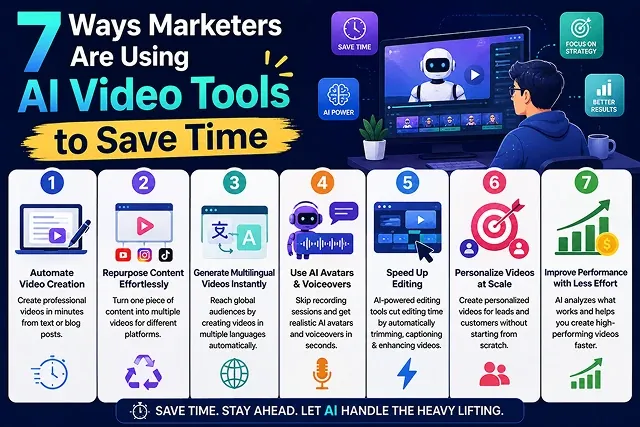
7 Ways Marketers Are Saving Time with AI Video Tools AI Video Tools
[Written Content / Product Data] ➔ [AI Text-to-Video Engine] ➔ [Multivariate Ad Variants & Localized Masters]
1. Instant Script-to-Video B-Roll Generation
- Instead of spending days searching through stock video databases or scheduling physical shoots, marketers feed blog posts, whitepapers, or text prompts directly into AI engines. Models synthesize matching 4K B-roll and visual scenes instantly, cutting pre-production time down to minutes.
2. Automated Multi-Language Dubbing and Voice Cloning
- Previously, a campaign needed to be localized if it had to succeed in international market. This translated to hiring foreign actors to read the text in their language as well as re-editing all the visuals to ensure consistency of sound and image. Nowadays, AI dubbing models come to the rescue: the systems translate and voice all the video content while synchronizing the speaker's lips in real time in many languages.
3. Swift Multivariate Advertising Creative Tests
- To have a successful advertising campaign, ongoing A/B testing must be done with various hooks, visuals, and calls to action. Instead of manually changing a lot of variations, marketers can use AI video creators to produce many different ad variations within a short time frame.
4. Text-Based Video Editing
- Manually going through a video timeline to edit raw video is laborious. Text-based editing applications have made it possible to make video cuts simply by deleting words and sentences from their generated transcripts.
5. Automated Customized Video Production for Various Uses
- To maximize responses, marketers can use personalized videos to increase the success of account-based efforts. With synthetic AI models, marketers can now produce customized video content at scale without recording anything directly.
6. Automated Formatting and Changing Aspect Ratio
- One marketing campaign must be on social media (YouTube 16:9, Reels/TikTok 9:16, 1:1 LinkedIn. AI auto-framing tools automatically re-crop visuals for you based on subject tracking across every social format, without needing to rework timelines.
7. Quick Reuse of Long-Form Materials
- The marketers can convert long webinars, podcasts, or demonstrations into short clips using ClipAI technology that is able to understand and cut into the necessary parts of the material with the possibility of creating the desired vertical format, using subtitles.
Efficiency Impact: Traditional vs. AI Production
Operational Benchmarks · Production Timeline & Cost Acceleration Matrix
| Operational Task | Traditional Production Timeline | AI-Accelerated Workflow |
|---|---|---|
| 30-Second Ad B-Roll | 3 to 5 Days (Shooting / Stock Search) | 3 to 5 Minutes (Generative DiT) |
| Global Localization | 1 to 2 Weeks per Language | Instant (Neural Audio & Lip-Sync) |
| Multi-Aspect Ratio Cuts | 2 to 4 Hours per Variant | Automated (Auto-Framing AI) |
| Multivariate Creative Testing | High Production Labor Cost | Near-Zero Marginal Cost |
Request A Custom AI Video
Tell us what you're trying to create and we'll point you to the right tool — or help you set it up.
Deep Dive: The 7 AI Video Marketing Workflows
1. Script-to-Video B-roll
- Generation Instead of combing through stock libraries or arranging real-time shoots, marketers input copy found in whitepapers, landing page copy, or blog posts into a text-to-video generator (e. G., 3.1 Google Veo or 2.2 Wan).
- Here to analyse the concepts and extract the themes before generating the corresponding 4k visualisations and the needed camera dolly, tracking, and crane movements, with overall pre-production being reduced by more than 90%.
2. Neural Audio Dubbing & Active Lip Syncing
- Previously localizing ad campaigns for a global market has necessitated employing and casting professional foreign language actors, studio time and painstakingly re-syncing timing.
- The new A2A translation engines (such as, ElevenLabs Dubbing v2) copy the original speaker's voice (their pitches, intonations, emotions, etc.), and render speech into over 90 other languages; and the new system automatically re-syncs the speaker's face to coordinate with the new language phonemes.
- [Original Video Asset] ➔ [Audio Stem Isolation] ➔ [A2A Neural Translation] ➔ [Lip-Sync Model Pass] ➔ [Localized Master]
3. Multivariate Dynamic Creative Optimization (DCO)
- Performance marketing is based on testing multiple variants of ads with the purpose to reduce Customer Acquisition Costs (CAC). Thanks to APIs-driven generation processes, marketers can create 20 to 50 different variants of one advertisement in a few seconds, which includes changing the hook used in the first three seconds of the advertisement, modifying the background visual and changing Call-to-Action texts, and constantly perform A/B tests by using the platforms like Meta Ads and TikTok.
4. Transcript-Driven Text-Based Editing
- Editing raw video by manually sweeping through the timeline is a time-consuming task. Modern marketers are using transcript-editing platforms (i.e. Descript or CapCut Desktop), where deleting a word, a sentence or a filler pause (“um,” “uh”) from the transcript makes the deletion of a corresponding video part painless and fast.
5. Automated Customized Outreach at Scale
- The use of personalized video messaging results in much higher open and conversion rates in Account-Based Marketing and sales outreach. Marketers can employ avatar APIs such as HeyGen or Synthesia coupled with CRMs such as HubSpot or Salesforce to generate personalized video messages on a massive scale with the automatic inclusion of customer names, company names, and customized messages into the videos.
6. Auto-Framing and Aspect Ratio Conversion
A single marketing campaign must fit multiple social media specifications:
- 16:9 Horizontal for YouTube and Desktop Web
- 9:16 Vertical for Instagram Reels, TikTok, and YouTube Shorts
- 1:1 Square for LinkedIn and Feed Ads
AI subject-tracking algorithms analyze the primary focal point across every frame, dynamically re-cropping and re-centering the visual framing automatically for every platform without requiring manual timeline editing.
7. Programmatic Short-Form Content Repurposing
- The long-form content such as podcasts, webinars, and customer interviews is made suitable for posting on social media by marketers with the help of AI clipping tools. The process uses NLP tools to identify interactive parts in content, convert them into brief snippets of 30-60 seconds, add animated subtitles, and create ready-to-publish vertical short clips automatically.
AI Video Marketing Primer
Discover how growth teams accelerate production, personalize ad campaigns, and automate cross-platform publishing.
The seven primary use cases transforming marketing efficiency include: 1. Rapid A/B Ad Variant Testing (generating multiple visual/hook variations in minutes), 2. One-Click Global Audio Localization (translating dialogue and lip-syncing into 40+ languages), 3. Automated Long-to-Short Repurposing (extracting viral clips from long webinars), 4. Instant AI Avatar Onboarding Videos (building product tours without filming actors), 5. Automated B-Roll Generation (synthesizing custom scene transitions from text prompts), 6. Automated Dynamic Subtitling (burning in kinetic captions instantly), and 7. Dynamic Personalization at Scale (customizing outreach videos for target sales leads).
Instead of spending thousands of dollars shooting a single promotional video ad, performance marketers use AI text-to-video tools to generate dozens of unique creative variations in parallel. By swapping out opening hook lines, changing background environments, or testing different AI presenter avatars, marketing teams can deploy extensive A/B split-tests across Meta, TikTok, and YouTube in a single afternoon.
Rather than hiring international voice actors and booking overseas studios, brands use cross-lingual voice synthesis engines (like ElevenLabs or HeyGen). These platforms take an original English campaign video, translate the script, clone the speaker's vocal tone, and re-render the presenter's lip movements to match the new language—enabling rapid distribution across international markets at a fraction of the cost.
Tools like OpusClip, Munch, and Klap analyze long-form video recordings (such as podcasts, webinars, or product demos) using natural language models. The AI automatically identifies high-retention highlights, crops the canvas layout to 9:16 vertical, centers the active speaker, burns in kinetic subtitles, and generates 10 to 15 short social clips in minutes.
Updating product walkthroughs or customer onboarding videos traditionally requires re-filming on-camera presenters whenever a UI feature changes. Using photorealistic AI avatars (from platforms like Synthesia or HeyGen), content managers can update training videos simply by editing text script lines, allowing instant updates without booking fresh video shoots.
Searching traditional stock libraries often leads to generic, overused footage that doesn't quite match a brand's visual identity. With generative AI video models (like Kling AI or Luma Dream Machine), marketers can input detailed text prompts or base brand images to generate unique, cinematic B-roll scenes tailored specifically to their campaign narrative.
Because over 70% of social media users consume video content with audio muted in public settings, uncaptioned ad campaigns lose a massive portion of their potential audience. Automated speech-to-text tools burn word-by-word kinetic captions onto the video timeline instantly, ensuring campaign messages resonate with sound-off viewers while boosting overall watch time.
Account-Based Marketing (ABM) teams utilize dynamic AI video generation to scale personalized outreach. By recording a single base video template, AI platforms can automatically swap out spoken prospect names, company details, and background website screenshots for hundreds of target leads simultaneously—delivering tailored video messages that drive significantly higher response rates.
Marketing teams switching to AI-driven video creation routinely report cost reductions between 60% and 85% compared to traditional agency production models. Lower asset creation costs allow growth teams to allocate more budget toward paid media distribution while maintaining a consistent schedule of fresh visual creatives.
Follow this 3-Step Integration Blueprint: First, deploy AI tools for high-volume, low-complexity tasks like short-form video repurposing and automated captioning. Second, implement generative B-roll and AI voiceover tools to accelerate paid ad variant testing. Third, layer in AI avatars and automated dubbing platforms to scale global onboarding and sales outreach seamlessly.
Ready to try Skora AI?
Transform your ideas into cinematic video in seconds.